Best starting point
Clean PDF exported from notation software
Vector or high-resolution PDF from Sibelius, Dorico, MuseScore, Finale, or a publisher.
- Expected MusicXML
- Usually produces the cleanest MusicXML structure, staff alignment, and rhythm totals.
- Review first
- Check repeats, volta brackets, lyrics, hidden voices, and any compressed cue-sized notation.
- PDF
- Full score or part
- Lowest review time
Strong fit
Flatbed scan of a printed part
Straight 300 DPI scan with full margins, high contrast, and all systems visible.
- Expected MusicXML
- Works well for parts, hymns, lead sheets, and small ensemble pages with standard notation.
- Review first
- Spot-check page turns, system breaks, ties across lines, slurs, tuplets, and small text.
- PDF, PNG, TIFF
- Printed source
- Moderate review
Usable when clean
Phone photo of a lead sheet
Bright, square-on photo where the page is flat and the staff lines are not warped.
- Expected MusicXML
- Can create a useful draft, especially for melody, chords, and simple rhythms.
- Review first
- Expect warnings around glare, shadows, skew, page curl, cropped measures, and handwritten marks.
- JPG, PNG, WEBP
- Single page
- Retake if cropped
Possible, review-heavy
Dense piano-vocal or ensemble score
Multi-staff score with lyrics, dynamics, articulations, rehearsal marks, or divisi.
- Expected MusicXML
- Often useful as an editable draft, but staff grouping and voice assignment need attention.
- Review first
- Review multi-staff alignment, lyrics underlay, collisions, repeated sections, and instrument labels.
- Multi-page PDF
- Many staves
- Focused cleanup
Try with caution
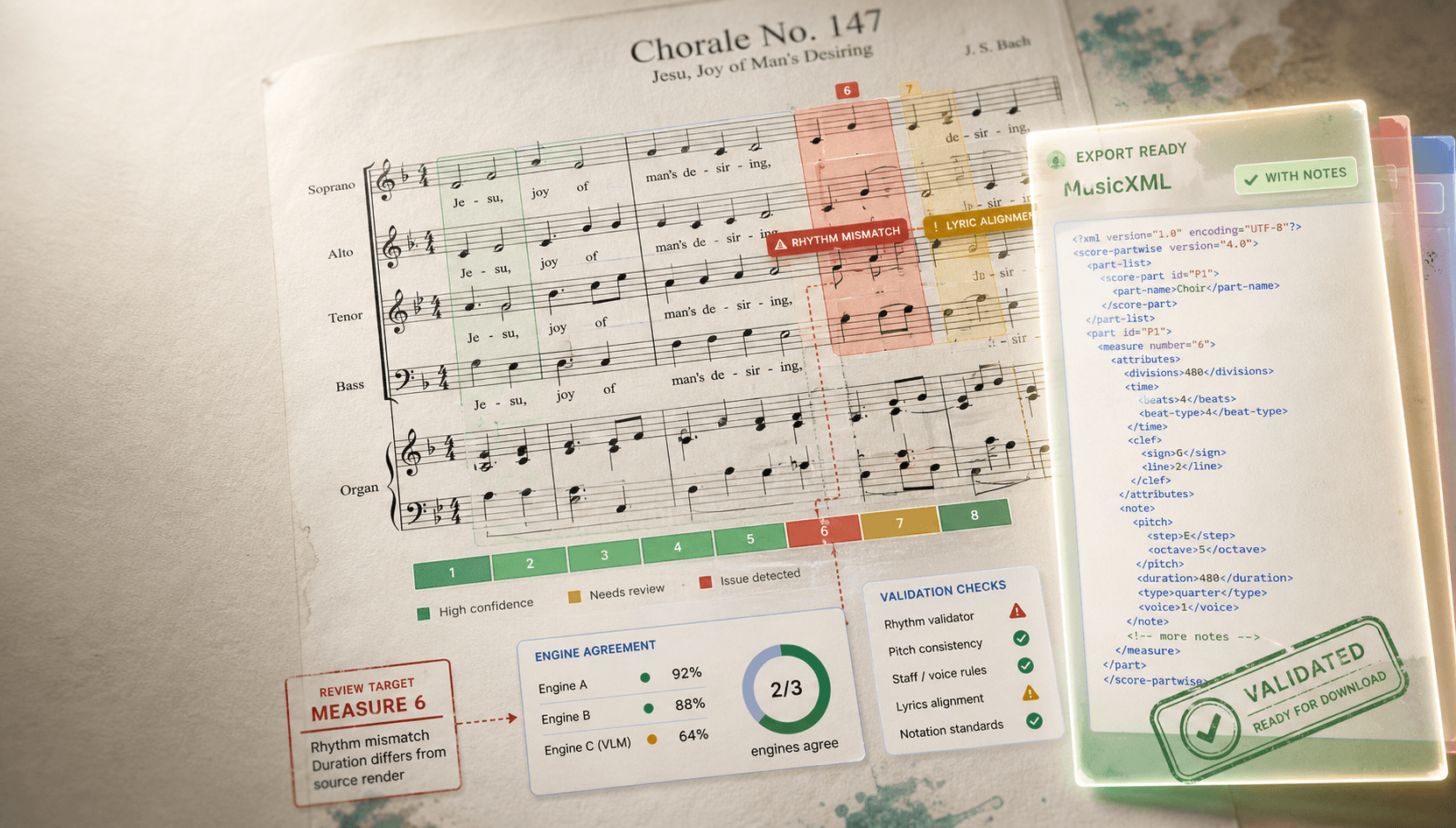
Old archive scan or low-contrast photocopy
Aged paper, speckling, page shadows, broken staff lines, or scans from bound volumes.
- Expected MusicXML
- May still extract useful notation, but warnings and blocked measures are more likely.
- Review first
- Fix source quality first when possible; then inspect every flagged rhythm, pitch, and system break.
- PDF or image
- Historic source
- High review time
Usually not ideal
Handwritten or heavily annotated music
Manuscript notation, classroom markings, pencil edits, crossed-out bars, or nonstandard symbols.
- Expected MusicXML
- Printed notation can sometimes be read; handwriting and heavy markings often need manual entry.
- Review first
- Use the report to identify what was recognized, then compare against the original bar by bar.
- Image or PDF
- Nonstandard notation
- Manual cleanup