Hymnal pages, made editable
A hymn in MusicXML can be transposed for the congregation, reset in larger notation, or reharmonized without redrawing it. StaveWave converts the scanned page into that starting point.
Hymnal conversion
Scan a hymnal page and convert it to editable MusicXML. StaveWave reads four-part harmony and multi-verse lyrics, then walks you through the bars it flagged.
Optimized for hymnal to MusicXML, hymn sheet music OCR, scan hymnal pages, hymnbook to MusicXML workflows with reviewable MusicXML output.

A hymn in MusicXML can be transposed for the congregation, reset in larger notation, or reharmonized without redrawing it. StaveWave converts the scanned page into that starting point.
Four-part harmony on two staves with three or four verses of text underneath is dense notation. That density is exactly where recognition gets uncertain, and where a check that points at the specific bar saves the most time.
Flatten the page as much as the binding allows, scan at 300 DPI or higher, and keep the spine shadow off the staves. A flat, even scan of the full page gives the cleanest read.
Processing stack
StaveWave shows the recognition engines, specialist passes, validation checks, and quality gates involved so users can see what checked the score before trusting the MusicXML.
Recognition passes
StaveWave compares independent readings of the notation and keeps disagreements visible instead of treating one reading as automatically correct.
Review checks
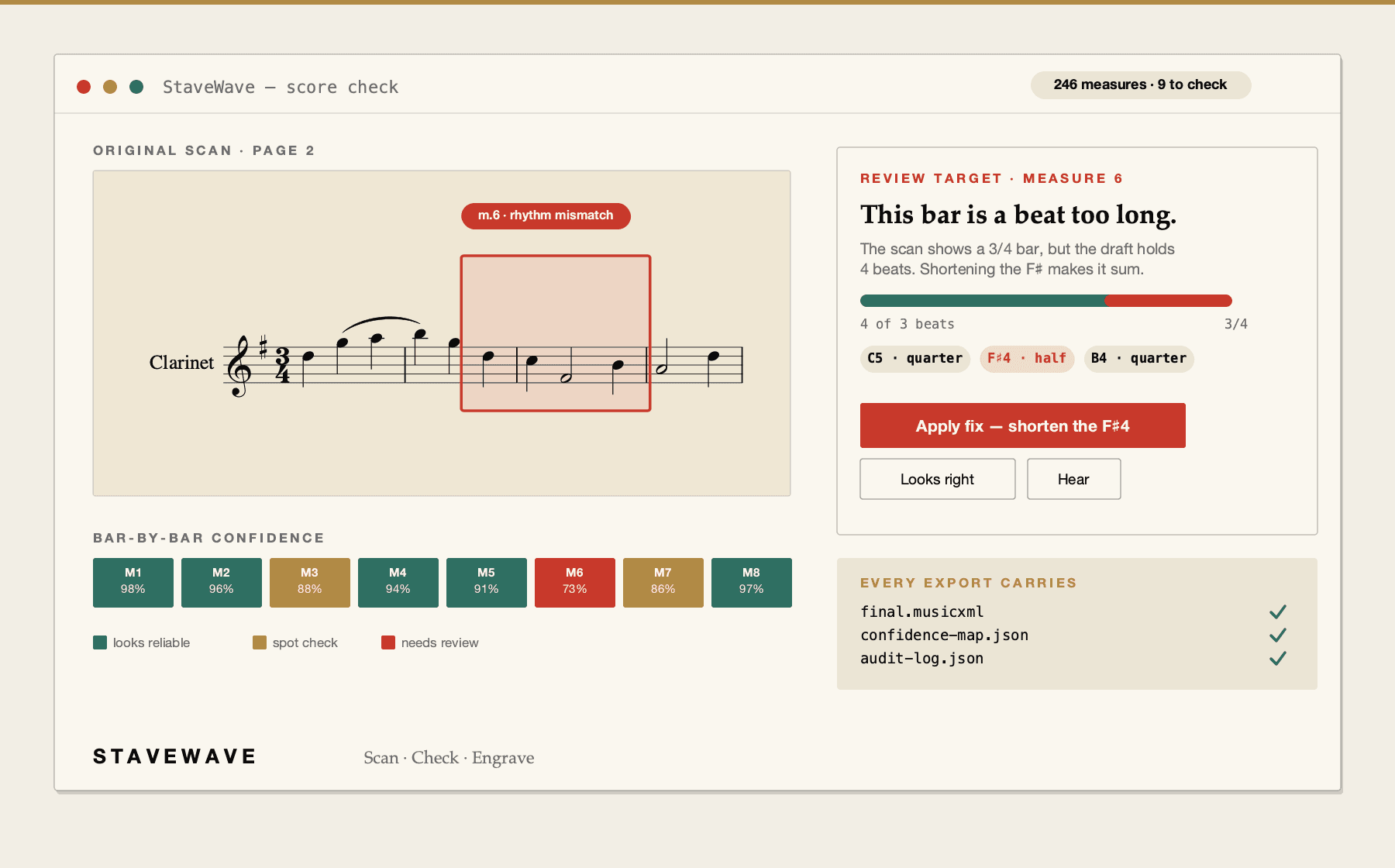
Visual, corpus, and notation checks inspect weak spots, compare the original scan against the rendered transcription, and flag suspicious measures or suggested fixes.
Specialist checks
Focused passes review pitch, rhythm, text, structure, articulation, and style so the output needs less cleanup in Sibelius, Dorico, MuseScore, Finale, or another editor.
Quality gates
Validation, consensus, visual comparison, audio checks, plausibility scoring, and audit evidence must run. If a required component fails, the job reports a blocking error.
Workflow
Flatten the page, scan at 300+ DPI, and keep the lighting even across the spine.
Submit the scan. StaveWave runs recognition, validates each measure, and flags the uncertain bars on your page.
Export for MuseScore, Sibelius, Dorico, Finale, or any app that reads standard MusicXML.
Questions
These answers match the structured data search engines receive for this page.
No. StaveWave runs online in the browser, so it works the same on Mac, Windows, Linux, iPad, or a Chromebook with nothing to install.
Multi-verse lyrics are recognized as separate verse lines under the notes. Stacked verse text is one of the harder cases, so the score check flags measures where the verse alignment was uncertain.
Press the page as flat as the binding allows and scan at 300 DPI or higher. Skew and spine shadow are the two things that hurt recognition most, so a flat page beats a high-resolution curved one.
Yes. The export is standard MusicXML, so transposition, reharmonization, and layout changes all happen in your notation app.
Multi-staff layouts are handled. The score check flags measures where staff alignment or density caused uncertainty so you know which systems to check.
Treat it as a verified draft. The score check walks you through the uncertain measures first, so you know what was flagged before you edit.
Ready to convert