Clear engraving, applied automatically
StaveWave applies standard engraving practice to note spacing, beam angles, lyrics, and dynamics.
Sheet music engraving
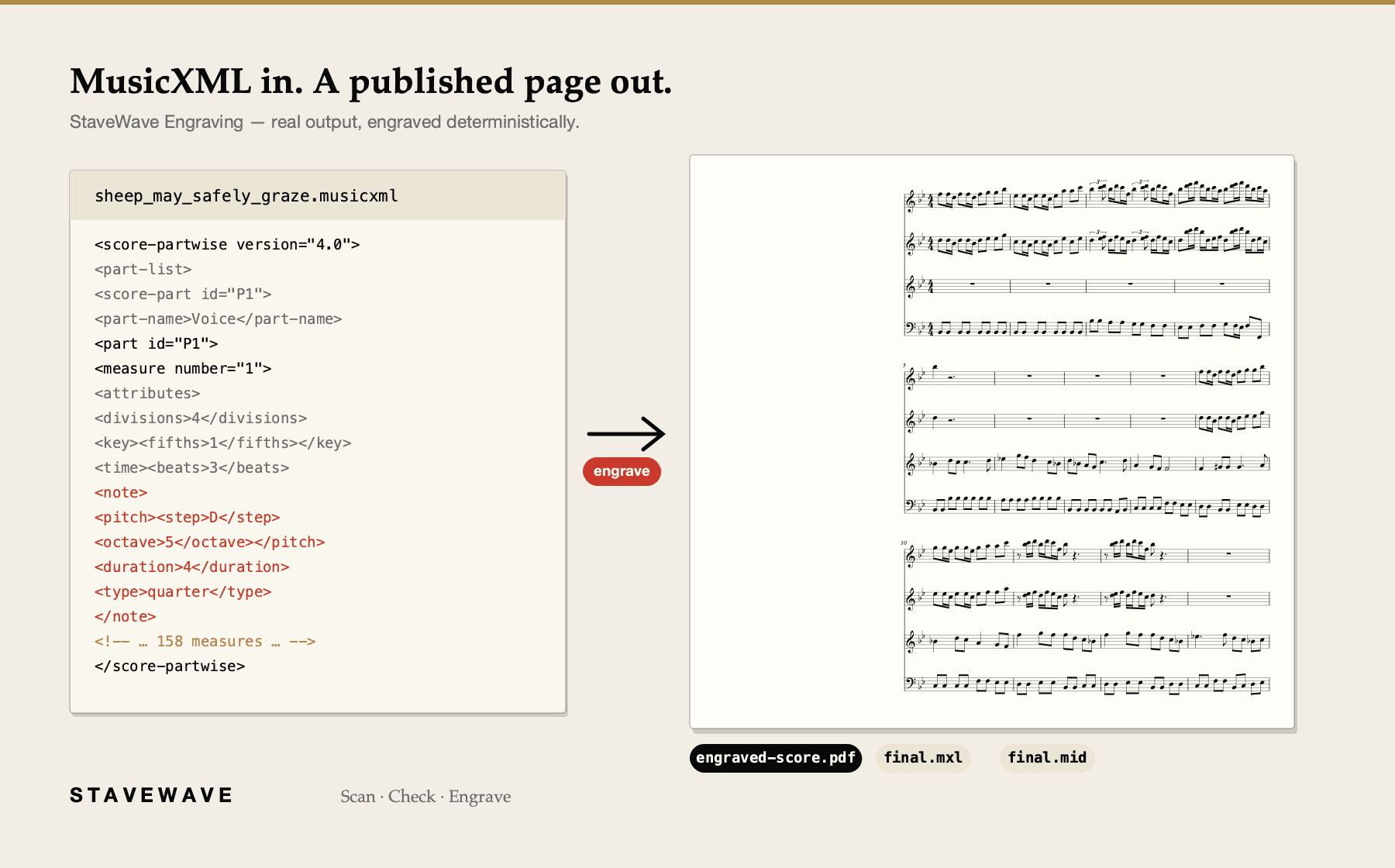
Turn MusicXML into a beautifully engraved, print-ready score — without installing desktop engraving software. Upload a file, get the edition — all online.
Get a print-ready PDF, compressed MusicXML, and MIDI.
No subscription or monthly fees. Start with 100 free signup credits. No credit card required.
Built for the work
StaveWave applies standard engraving practice to note spacing, beam angles, lyrics, and dynamics.
One upload gets you every output the job produces — see the FAQ for the full list.
The same MusicXML produces a consistent layout, calculated and checked against notation rules.
How StaveWave checks a conversion
StaveWave calculates layout, checks notation rules, and renders a consistent page from the same file.
Layout engine
Note spacing, system breaks, and page turns are calculated from the music, following standard engraving practice.
Collision checks
The engraver checks spacing to reduce collisions between lyrics, dynamics, and articulations before rendering.
Notation rules
Beam angles, stem directions, accidental stacking, and tie shapes follow standard engraving practice, so the output reads like a published score.
Consistent layout
Re-engrave the same MusicXML to produce a consistent layout.
Steps
Upload MusicXML or MXL from any notation app.
The score is parsed, validated bar by bar, and engraved with published-edition layout conventions.
Download everything from one results page.
Questions
Engraving applies the layout conventions of published editions — optical spacing, collision avoidance, considered page turns — rather than a one-size-fits-all default layout.
Yes. Convert the scan to MusicXML, review the flagged measures, then send the result to the engraver.
A print-ready engraved PDF, compressed MusicXML (.mxl), MIDI, and SVG and PNG page exports.
Yes. Full scores with many staves use automatic system layout.
Ready to convert