MIDI comes with every result
Whether you convert a scan or engrave an existing MusicXML file, the results page carries a MIDI rendering alongside the notation. There is no separate step and no second upload.
Practice and rehearsal
Convert a printed score online and get MIDI alongside the MusicXML — playback that matches the notation you verified, for rehearsal and part-learning.
Optimized for sheet music to MIDI, practice MIDI from sheet music, scan sheet music to MIDI, rehearsal tracks from sheet music workflows with reviewable MusicXML output.

Whether you convert a scan or engrave an existing MusicXML file, the results page carries a MIDI rendering alongside the notation. There is no separate step and no second upload.
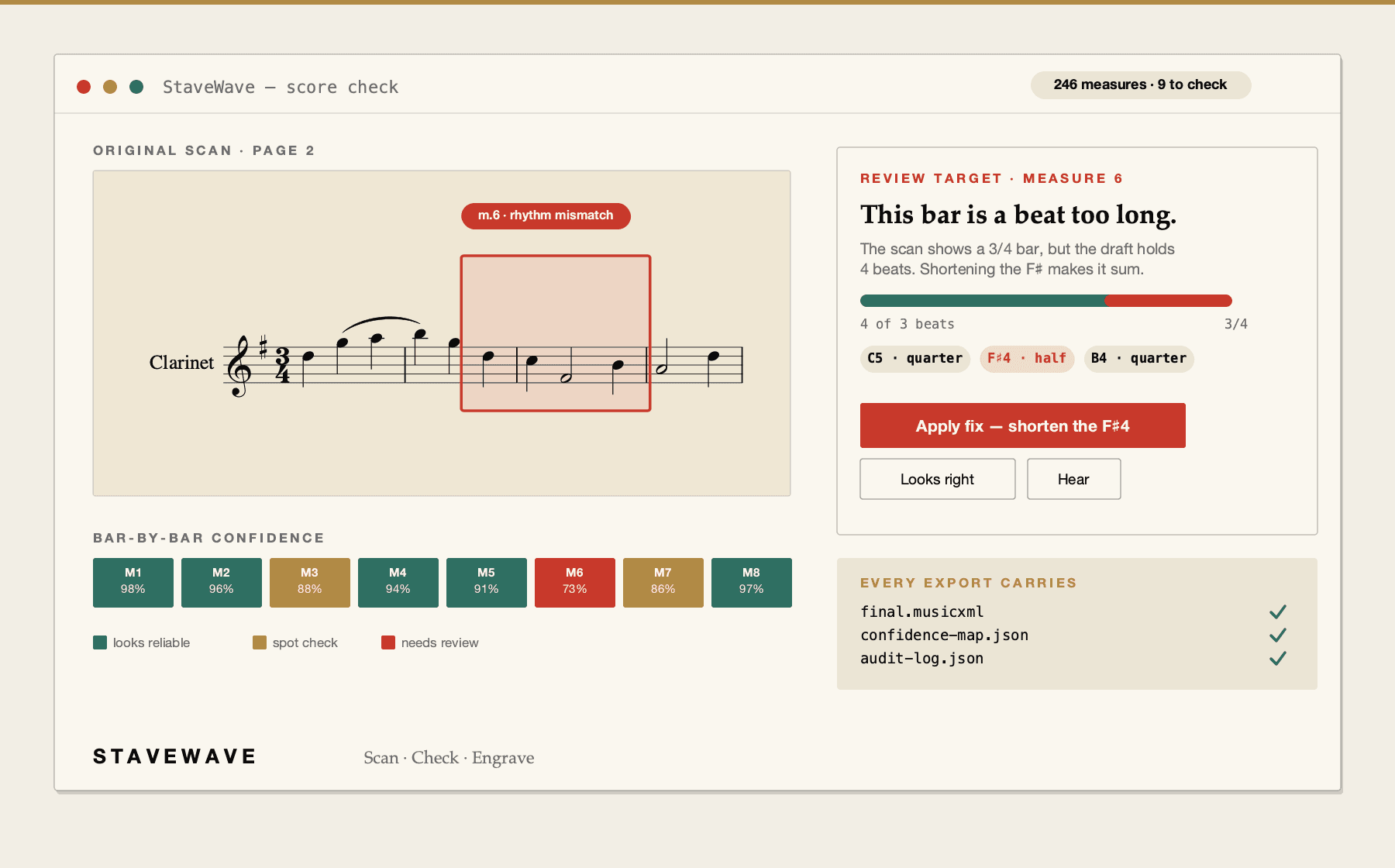
The MIDI is rendered from the same score you reviewed, so what you hear is what the score check validated — not a parallel guess at the music.
Open the MIDI in your notation app or DAW to solo a line, slow the tempo, or bounce a rehearsal track for each singer or player.
Processing stack
StaveWave shows the recognition engines, specialist passes, validation checks, and quality gates involved so users can see what checked the score before trusting the MusicXML.
Recognition passes
StaveWave compares independent readings of the notation and keeps disagreements visible instead of treating one reading as automatically correct.
Review checks
Visual, corpus, and notation checks inspect weak spots, compare the original scan against the rendered transcription, and flag suspicious measures or suggested fixes.
Specialist checks
Focused passes review pitch, rhythm, text, structure, articulation, and style so the output needs less cleanup in Sibelius, Dorico, MuseScore, Finale, or another editor.
Quality gates
Validation, consensus, visual comparison, audio checks, plausibility scoring, and audit evidence must run. If a required component fails, the job reports a blocking error.
Workflow
Submit a PDF or scan of printed notation, up to 100 MB and 50 pages.
Review the flagged measures and play any bar to hear rhythm errors before you trust the playback.
Both arrive on the results page, ready for your notation app or DAW.
Questions
These answers match the structured data search engines receive for this page.
No. StaveWave runs online in the browser, so it works the same on Mac, Windows, Linux, iPad, or a Chromebook with nothing to install.
No. MIDI is produced with every conversion and every engraving job and appears on the results page next to the notation files.
Yes. It is rendered from the verified score, so any measures you corrected during the score check are reflected in the playback.
The MIDI is rendered per part from the verified score, so you can solo or mute a line in your notation app or DAW and bounce per-part rehearsal audio.
It is exactly as accurate as the notation it came from. That is why the score check runs first — bars flagged as uncertain are the ones to verify before relying on the audio.
Tempo and dynamic markings that made it into the MusicXML carry into the playback. The score check flags measures where recognition was uncertain so you know what to check.
Ready to convert